
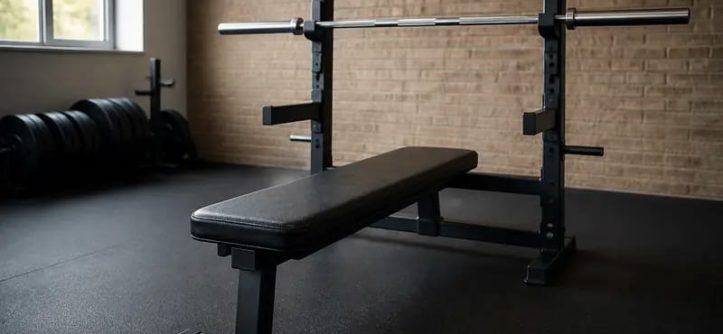
Even more important than the weight of the bar though is getting the exercise right. So here is how you can set up your body for the exercise and keep to good form for the entire rep.
Get Five Points Of Contact First
Start by getting your body into the correct position on the flat bench before touching the bar or the weights. This means your head, shoulders and glutes should all be resting on the bench, and your feet planted firmly on the ground. This will give you a solid five-point contact with the bench and stop your lower back from arching off the bench. Many people’s worst offender for soreness and feeling wobbly after a workout for chest is the lower back.
Plant Your Feet And Drive Down
In addition to supporting your body and keeping your lower back flat, your feet should be driving down into the floor as you lift the weight up. This enables you to get more power from your feet, hips and legs, meaning that you are lifting the weight with your legs and hips rather than putting all the strain on your arms and shoulders. This means that you are building up to the lift from the floor with your feet.
Pin Your Shoulder Blades Before You Lift
Retract your shoulder blades before you start the exercise. This helps to protect your joints and will help to support the bar on your chest. Avoid allowing your shoulders to roll forward or lift off the bench during the press as this can cause serious damage to your muscles and joints. The Chartered Society of Physiotherapy has a lot of information on how to protect your lower back during exercise, but this also applies to protecting your shoulders when bracing on a bench.
Choose A Grip That Keeps Your Wrists Stacked
As a general rule, the wrists should be directly above the elbows at the bottom of the movement. This usually means that for a standard press, the grip will be slightly wider than shoulder width. There are many variations of the bench press and if you go for a too narrow grip, your elbows will most likely be flaring out. For a too wide grip, you risk losing power in the movement and placing too much stress on your shoulders. A flat weight bench with grip rings marked on the bar for different areas can be useful as you can set up the bench for the starting point of the movement for a specific exercise to be used for repetition for later sessions.
Control The Weight On The Way Down
SLOWLY RETURN THE WEIGHT TO THE starting position over a period of time such as two to three seconds. Then pause for a moment before raising the weight again.
If you want Flat Weight Bench, https://uk.repfitness.com/collections/flat-weight-benches/ is a good place to start.
Breathe Properly Through Each Rep
Although you’ve been practising the different movements for the various exercises, breathing properly will become second nature no longer when you add weight to the bar. So remember to take a breath in and tighten your core prior to lowering the weight down to the bottom of the movement. Hold this position throughout the hardest part of the movement and then exhale out as you raise the weight back up to the starting position. Building strength safely at home is covered by NHS advice for strength work in general.
Use Collars, Safety Arms And A Spotter For New Weights
Use collars to stop your weight plates rolling around on your bar and, if your bench or rack has safety arms, make sure they are set up correctly before trying a new weight. You will need a spotter for some of these too. If you can’t manage to lift a rep then rather than failing and risking injury drop the weight slightly and try again. The national governing body for weightlifting (again) provides good advice on proper weightlifting technique and it’s all about having a good safety plan in place before you start to test yourself.
Adjust Form Slightly For Different Exercises
Presses, flyes and skull crushers all use the same basic setup. However, there are slight variations to the form of each exercise. For flyes, you need to keep a slight bend in your elbow throughout the rep and don’t let it go to full lockout. For skull crushers, keep your upper arms still and only move your forearm. For presses, make sure you are driving force from your feet up to the bar. It’s worth getting a session of qualified fitness instruction to learn how to do these exercises and apply the above points before adding weight.
Good form on a flat bench is really quite straightforward. There are five points of contact for your body and then the rest of the exercise follows from there. You just need to be aware of your body position for the warm up and then for the rest of the session.


Leave a Reply