
Two climbers may attempt the same bouldering problem yet one will complete it while suffering greatly and in agony whilst the other completes it easily with minimal effort in their body. What is the difference between the two climbers? Most people assume it is to do with the strength of the climber; however, there is much more to climbing than just pure strength. In fact, a large proportion of climbing is down to the footwork.
Use Your Big Toe, Not Your Whole Foot
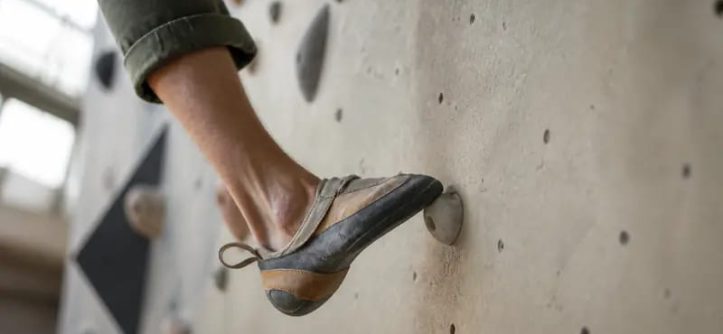
Most new climbers try to cover as much of the sole of their foot as possible to a hold. When experienced climbers use very small foot holds, they will often try to touch the hold with the very tip of their big toe, or even the very edge of the sole of their foot. This is because climbing shoes are most powerful at the big toe, so by trying to place the very tip of it on a small hold you can get a much better grip than by placing the whole sole of your foot on it. For your practice try to place the very corner of your big toe on small foot holds.
Keep Your Heels Down
It’s essential to keep the heel of your foot down when climbing. Dropping your heel will allow you to keep tension in your calf muscles which in turn will keep the toe of your shoe dug into the hold, preventing it from rolling off. If you allow your heel to rise then the rubber of your shoe will lift away from the wall of the hold. This will allow your foot to skate off the hold, especially if the edge is small.
Place Quietly, Don’t Scrape
When moving around on the wall, aim to place your feet on holds in a ‘quiet’ and deliberate manner. This means that instead of looking at the hold that you are placing your foot on and then moving it there, you would look at the hold first and then plan out exactly where your foot is going to go before committing to the placement. This type of movement is in contrast to ‘scuffing’ around on the wall until you accidentally place a foot on a hold.
Trust Small Holds Early
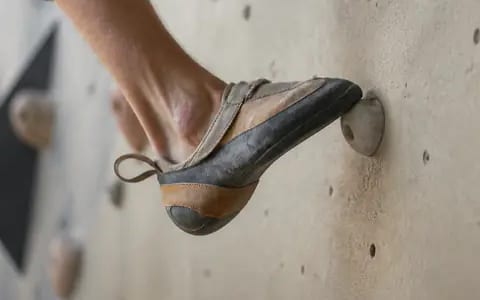
Half-weighing a small foot hold can be even worse than full-weighing it initially. The rubber in your soles will grip under a steady, even load better than under an uneven, wobbly one. This is why, as soon as you trust a foot hold, you should go to full weight on it instead of continually rocking back onto it. Also, don’t forget that your arms are supposed to be doing less work than your lower half here, so make sure they are.
There is more on Bouldering at 270 Climbing.
Try Heel Hooks and Toe Hooks
On steeper bouldering problems the hooks with your feet can be as powerful as steps with your feet. The heel hooks on a sloping edge of a ledge or toe hooks under a lip will pull you into the wall and stop you from falling. This can take a huge amount of pressure off your arms and help you complete more climbs. As with any new bouldering move it is best to practice on the easier versions first before stepping up to the more difficult bouldering routes.
Backstep on Sideways Moves
When climbing sideways through a route, turn your hips to face the wall, and place the outside edge of your foot on the hold. This opens up your side and allows you to reach further with less effort than if you were to reach for the handhold with your arm. Back stepping, as it is referred to, is a fundamental technique that should be developed on traverses of relatively low grade, to allow for slower ascetic practice.
Set Your Feet Before You Move
Remember, to be able to reach for a handhold with balance, your feet have to be in the right position first to support your body in that position. So before you even think about where to place your hands, work out where your feet need to be for that hand position and place your feet first.
Slow Down on Easy Routes to Practise
You don’t develop precise footwork on hard routes where every move could potentially be your last. Practising on the lower grade versions of your favourite bouldering problems means you can go at a slow pace and really perfect every step of the route. Focus on replacing handholds with foot holds wherever possible, to really practice your balance and lower-body control.
Good footwork is controlled balance and can be developed by slowly trying to place one foot after another on holds for foot placements. See the 270 Climbing bouldering pages for a tour of what you can expect to do in a typical bouldering session and try incorporating more foot placement focused routes in to your sessions to improve your overall climbing.



Leave a Reply